
"disease resistance"
1000 article(s) found

Bolivian fine coffee beans with rich sour taste
Bolivia not only has a unique growing environment, but also has an excellent coffee variety Typica. For 200 years, the coffee varieties in Yangas have been dominated by the ancient Tibica. The Tibica variety has a balanced and soft flavor, with lively aromas and rich acidity. Unfortunately, Tibica's yield is low and its disease resistance is poor, making Bolivia's

A Brief Introduction to the Treatment Method of Grind Degree and Roast Degree of Katim Fine Coffee Beans with Stable Yield
Katim is a variety introduced later. Its yield is relatively stable. It is resistant to diseases and insect pests. It is planted in large areas in Yunnan. It is easy to buy Katim beans on the market now. Katim aa beans are also exported beans. Generally speaking, it is not bad. Not to mention in China, even in the whole of Asia, Yunnan beans are considered very excellent. As for cat poop, mantenin, etc.

Prevention and control of small-grain coffee diseases (coffee rust, coffee anthracnose)
1. Coffee rust is the main disease of coffee, the most harmful, the damaged plants, light reduced yield, serious death. Coffee rust is mainly harmful to leaves and sometimes to young fruits and twigs. After the leaves were infected, many light yellow spots appeared at first and enlarged in the form of water stains, followed by orange-yellow powdery spores on the back of the leaves, and there was a light green halo around the disease spots, which gradually expanded or connected in the later stage.

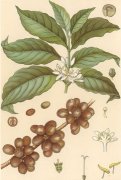
Do you know what coffee bean trees look like? do you know the varieties of coffee beans?
For more information on coffee beans, please follow the Coffee Workshop (official Wechat account cafe_style) Coffee trees are flowering plants of the genus Rubiaceae, ranging in size from small shrubs to 18 meters tall. Wild coffee species grow irregularly in the tropics, and new species are still being discovered. Strictly speaking, coffee belongs to

A brief introduction to the planting situation of Katim boutique coffee beans suitable for deep baking, geographical location, climate and altitude
Catimor: in 1959, the Portuguese mixed Brazilian Kaddura and Timo to develop a disease-resistant Katim / Katimo, which is now an important variety of commercial beans. Coffee is a short-day plant. Coffee has the characteristics of multiple flowering and concentrated florescence. The florescence of small seed coffee in Yunnan is 27 months, and the flowering period is 35 months. The flowering of coffee is affected by the climate, especially the rain

A brief introduction to the cultivation of Katim boutique coffee beans with obvious fruit flavor, geographical location, climate and altitude
Katim is a variety introduced later, with a relatively stable output and strong resistance to diseases and insect pests. It is planted in a large area in Yunnan, and now it is easy to buy Katim beans on the market. Katim aa beans are also exported beans, which is not bad on the whole. Not to mention in China, even in the whole of Asia, Yunnan's beans are very excellent. As for cat shit, Manning, etc.

A brief introduction to the History and Culture of the Origin and Development of Katim Fine Coffee beans with stable production
Katim is a variety introduced later, with a relatively stable output and strong resistance to diseases and insect pests. It is planted in a large area in Yunnan, and now it is easy to buy Katim beans on the market. Katim aa beans are also exported beans, which is not bad on the whole. Not to mention in China, even in the whole of Asia, Yunnan's beans are very excellent. As for cat shit, Manning, etc.

What are the main varieties of coffee beans
The Robastian coffee tree, which originated in the Congo in Africa, accounts for about 20% to 30% of the world's production. Luoba Jinta coffee tree is suitable for planting in the lowlands below 500 meters above sea level, has a strong adaptability to the outside world, can resist bad weather, resist diseases and insect pests, and is in soil preparation. Weeding and pruning do not require much manual care, and can be allowed to grow in the wild, which is easy.
Introduction to the types of Fine Coffee
In plant taxonomy, coffee belongs to the Genus Coffea family of Rubiaceae, and there are at least a hundred varieties of coffee under it. In the healthy Life post "falling in love with boutique coffee", I mentioned that the more common coffees are Arabica (Arabica, elegant flavor, is the main boutique coffee) and Robusta (or sturdy beans, rough flavor, caffeine content
Cultivation techniques of Yunnan Coffee with small grains
Disease control: 1. Coffee rust is the main disease of coffee, the most harmful, the damaged plants, light reduced yield, heavy death. Coffee rust is mainly harmful to leaves and sometimes to young fruits and twigs. After the leaves were infected, many light yellow spots appeared at first and enlarged in the form of water stains, followed by orange-yellow powdery spores on the back of the leaves, and there was a light green halo around the disease spots, and the disease spots in the later stage.

Scientists propose new way to fight coffee leaf rust
Coffee scientists from all over the world have come to Colombia's Eje Cafetero region, a hillside populated by thousands of small coffee farmers.

Prevention and control of coffee rust is the main disease of coffee.
1. Coffee rust is the main disease of coffee, the most harmful, the damaged plants, light reduced yield, serious death. Coffee rust is mainly harmful to leaves and sometimes to young fruits and twigs. After the leaves were infected, many light yellow spots appeared at first and enlarged in the form of water stains, followed by orange-yellow powdery spores on the back of the leaves, and there was a light green halo around the disease spots, which gradually expanded or connected in the later stage.

A brief introduction to the History and Culture of the Origin and Development of Arabica Fine Coffee beans
Arabica? The planting conditions of coffee are harsh, requiring higher elevations (above 2000 meters above sea level), fertile soil fertility, adequate moisture, proper sunshine conditions and shade. Arabica? Coffee tree species have poor ability to resist diseases and insect pests and are easy to be damaged. In addition, the annual output of coffee trees per unit area is also lower. At the moment? Arabica? Grow coffee

An incomparably rich variety of coffee, Bourbon variants Pacamara, Kaddura, Kaduai and Sachimo
Professional coffee knowledge exchange more information about coffee beans Please follow the coffee workshop (Wechat official account cafe_style) bourbon is as old as tin pickup. Bourbon: a variety of early (prehistoric coffee) iron pickups that changed from a thin tip to a round shape after being transplanted to Yemen. In 1715, France transplanted round beans from Yemeni mocha to bourbon on the east coast of Africa.
Varieties and characteristics of Arabica Coffee
Arabica Coffee varieties and their characteristics Typica this is the closest Arabica species to the native species, almost all Arabica coffee varieties are derived from this. Used to be widely cultivated in Central and South America, the bean shape is long and has excellent sour taste and aroma, but it is not resistant to leaf rust and requires quite a lot of shading trees, resulting in low yield (sweet with bourbon every two years).

What's the difference between Arabica coffee beans and Roberta coffee beans? Arabica Coffee Tree Robbas
Different planting conditions [Elaraby Kadou] Arabica coffee has more stringent planting conditions, weak disease resistance, higher altitude requirements, slower growth, higher quality, and more refined processing of raw beans. Growing at colder altitudes in the tropics, it is an important kind of commercial coffee with a fruiting period of less than three years and a high-quality aroma and sour taste. Arabica coffee bean owner

Introduction to the quality characteristics of Yunnan Tieka Coffee Bean Flavor description treatment
Yunnan Typica Coffee: the oldest native variety in Ethiopia and southeastern Sudan, all Arabica are derived from Tibica. The flavor is elegant, but the physique is weak, the disease resistance is poor, the fruit yield is less. Excellent manor beans such as the Blue Mountains of Jamaica, Manning of Sumatra and Kona of Hawaii all belong to Tibika. The parietal leaf of Tibika is

Flavor and taste characteristics of Yunnan Tieka coffee beans introduction to Katim Brand Manor
The so-called new variety actually refers to catimor (Katimo), which is a hybrid of the timor species of the Roberta family and Arabica. Compared with the old varieties, it lacks rich aroma and flavor, and has a relatively shallow smell of grass and soil, but its advantages are pest resistance, easy management and yield.

Coffee Art and Technology-Coffee plants and Classification-Why is the flavor of Katim coffee beans so bad?
Professional coffee knowledge exchange more coffee bean information please follow coffee workshop (Wechat official account cafe_style) Katim coffee beans coffee plants and plant classification coffee botanical classification coffee Rubiaceae characteristics of three kinds of coffee beans let us botanically subdivide coffee plants. Coffee is a shrub, part of the Rubiaceae family. Classification of 73

How many regions and characteristics of coffee species are roughly distributed in the world?
Professional coffee knowledge exchange more coffee bean information Please pay attention to the coffee workshop (Wechat official account cafe_style) Coffee beans can be divided into Arabica species and Robusta species in the global coffee, Arabica species account for about 70% of the total output, has important commercial value. Arabica species spread from the Arabian Peninsula to all parts of the world, depending on the route of transmission.